Oliver H. Creighton, Robert Liddiard, Alan K. Outram, Carly Ameen, Kate Kanne (eds.)
Medieval Warhorse. Equestrian Landscapes, Material Culture and Zooarchaeology in Britain, AD 800-1550
(Liverpool University Press, 2025), 464 pp. $64.00
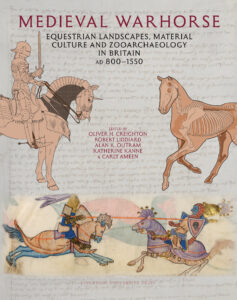
Horses, and warhorses in particular, belong to the popular imagination of the Middle Ages as much as knights, cathedrals and castles. Yet, many misconceptions still persist regarding their real appearance and use. In recent years, several studies have appeared in various historical fields aiming at a better knowledge and understanding of the medieval equine in Europe and beyond. One of them, Warhorse: A Medieval Revolution?- a research project run between 2019 and 2023 by a group of historians and archaeologists from British and Irish universities- had the ambition to conduct the first ever systematic study of warhorses (and horses in general) in Medieval Britain between the Late Saxon and the mid-Tudor periods (800-1550), mostly through archaeological evidence. The present book gathers the results of this project, confronting popular images of the medieval warhorse with its historical and archaeological reality, using new types of sources and material to answer questions and complete previously known documents. In eleven chapters, including introduction and conclusion, the various authors reconstruct the appearance, the environment, and the social and military place these horses held in Medieval Britain.
After a first introductory chapter where the authors set up the goals and the sources of their project, a second chapter develops a very useful “historical chronology” of the presence and role of warhorses in Medieval Britain from the 9th to the 16th century. Serving as a background for the following chapters, this first part discusses the various forms and uses of horses at war, in which destriers were actually present in relatively small proportions, and in a region where, even after the Norman conquest, dismounting for battle remained a common practice.
The third chapter explores the various interlinked networks governing the lives of elite horses in England over the period, mostly through historical geography. Thanks to the study of archival documents and traditional historical landmarks, this part reveals the long-term continuity of the areas used to breed horses due to their specific needs. These first observations are then cleverly completed in chapter four, focusing on equine infrastructure, in particular stables, studs, and tiltyards. Here we learn what archaeology revealed of the materiality of the places reserved for horses in castles and other aristocratic residences, showing sometimes the high degree of care these prized animals received in the wealthiest households.
The fifth chapter explores the representation of horses and riders in visual arts over time, with a particular emphasis on the perhaps less-studied pre-Conquest period on this matter. The author stresses the challenges of using Medieval arts as a reliable source for horses, despite the precious insight and data they can bring about riding styles and the animal’s appearance. Completing this first artistic approach, the author of the following chapter studies the equestrian material of the British horse – at least the parts that can be found in archaeology – and its evolution. Bits, stirrups, and other harness fixtures and ornaments contribute to better understanding the materiality of the medieval (war)horse, and its social role.
Horse armor and horseshoes are the topic of chapter seven. If the direct connection between these two forms of iron equestrian equipment may not be obvious, authors chose to combine them in their study because of the close relationship they both have with horse physiology. They present how this material can be used to better know the size and morphology of warhorses. This particular concern is the central point of the eighth chapter, presenting the results of the nation-size analysis of medieval horse skeletons found on English archaeological sites, undertaken by the zooarchaeologists of the Warhorse project. Among other things, this unprecedented collecting of data informs us on the conformation, pathologies, and genetics of medieval English horses, allowing some tentative conclusions on the diverse activities these animals undertook between the 9th and 16th centuries. Above all, these bones revealed the evolution of the average horse size in England over the studied period, relatively small for modern standards, despite a growing curve towards the late and post-medieval times. This discussion on horse stature is the focus of chapter nine, bringing together this fresh-new data with other historical evidence available. Despite the zooarchaeological study not focusing on the remains of warhorses (undistinguishable from the others), the results once for all help to wipe away the popular image of knights riding giant heavy steeds: such animals, developed 200 years ago during the Agricultural Revolution, simply did not exist in medieval times.
Finally, before the general conclusion of this volume, a last chapter explores the social context of the medieval horse, and the nature of its unique relationship with humans, especially for the elite. Following once again a chronological line, authors reveal the continuity of this exceptional position, from the Anglo-Saxon period to the reign of the Tudors.
As a result, Medieval Warhorse constitutes a precious nation-sized case study for the knowledge of medieval horses. The combination of archaeological and historical evidence gives this volume an original approach and further highlights the interdisciplinarity such topics require to fully address their complexity. Authors are nonetheless often confronted with the limits of their own project: the English context does not always provide enough evidence for large relevant conclusions (like for the study of horse armor for example), and archaeology often struggles to really distinguish between warhorses and other horses, a problem seen in their studies on equine infrastructure and skeleton remains. If, as a result, this volume tells us sometimes rather more about the horses of the British elite in general than specifically warhorses, it remains an important milestone in a scholarly context increasingly sensible to the history of non-human creatures and their place in society.
Marina Viallon
Assistant Curator, The Metropolitan museum of Art, Arms and Armor dept
[email protected]