Georgios Theotokis and Mamuka Tsurtsumia (eds.)
Nikephoros II Phokas and Warfare in the Tenth Century Byzantine World
(Brill, 2025), 464 pp. $160.00
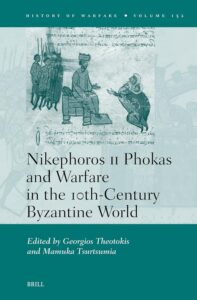
Military history is sometimes disparaged; even more so, the study of “great men”. Nevertheless, contemporary mores cannot diminish Nikephoros II Phokas’ stature as a warrior-emperor often demonized and, even more so, venerated (1). Phokas personified (and engineered) the revival of imperial fortunes. This book is not a multi-dimensional biography, however. Rather, the collection stages a mise-en-scène, the drama of Byzantium’s Reconquista. No narrative is needed or desired. Instead, the anthology is integrated thematically through leitmotifs consolidating the volume, hence the annoying cross-referencing in this review.
Jettisoning traditional biographical formatting, Jean-Claude Cheynet proffers an exordium illuminating genealogy, patronage, and dynastic association in the late ninth and early tenth centuries. The author occupies himself with Byzantium’s temporal totality. No man is an island, and Cheynet proves that adage. He outlines broadly Phokas’ socio-political circles, explaining why the “pallid scourge of Saracens” effloresced when he did (a theme woven by other contributors, for example Denis Sullivan, 301). Dynasticism is not underestimated. Traditionally, nuptials proved as decisive as military victory for the Phokades. A numismatical annexe follows Cheynet’s initiatory presentation, undergirding his tableau. Material culture, specifically protospatharian mintage, reveals linkages within Byzantium’s composite aristocratic networks that solidified patronage and familial connection.
Similarly, Gennadiy Baranov uses bladed weapons to map exchanges of commodities. The diffusion of martial habiliments betwixt warring parties reveals the socio-economic network transacted among entangled allies and adversaries. Byzantium’s interactions with states and nomadic groups are revealed by a diaspora of stylistic templates for swords. Their genre, provenance, chemical composition and sleeve cross-guard patterns “reflect the complexity and ambiguity of interstate relations in the mid-Byzantine Mediterranean” (180). Variations in design are made manifest in their component parts: quillons, collars, and sleeves. Baranov displays perspicuous archaeological specimens and gathers iconographic evidence from painted miniatures. This evidential dimension complements the literary approaches of Marco Miotto, Georgios Chatzelis, Filip Schneider, Konstantinos Karatolios, and other contributors.
Marco Miotto brings to bear his mastery of language by utilizing primary sources impenetrable to those of us unschooled in Arabic. Miotto’s is no mean feat as his achievement goes beyond translation and draws from non-western sources more familiar western European formularizations; he translates concepts as well as words. The author does so by peering through a trio of lenses: historiographical narrative, political and military analysis, and geopolitical perception (203). Miotto categorizes Arab historians whose treatment of Phokas predictably followed the “schemi della cronaca annalistica” that should be distinguished from the scarcer “racconto più omogeneo” (225, 375). The latter’s historicity is more reliable because modern eyes too easily construe Arab chronicles according to a dramaturgical model. The convenient binary of “us” and “other”, so ably set forth in detail by Chatzelis and other contributors, is embellished throughout the book.
The obverse to Marco Miotto’s piece is Filip Schneider’s investigation of Byzantine renderings of the “other”. Schneider explains how ethnic and cultural boundaries shifted the “merging of positive Christian aspects [e.g., humility and steadfast conviction] with Byzantine self-identification” (251). Different ethnicities and faiths were attributed stereotypic attributes in Byzantine literature’s public sphere. Two common denominators permeate those perceptions. First, the “other” was the aggressor (for example, the “blood-lusting” Arabs occupying Crete, 251). Never the instigator, the pious and peace-loving Empire presented itself as on the defensive, the latter policy resonating Byzantium’s traditional foreign policy. Second, a quasi-ecumenical mass psychology rallied Christian populations around Hagia Sophia. Via discursive analysis and rhetorical scrutiny, Denis Sullivan elucidates mentalités in poetic compositions and historical chronicles. Highly charged and savage characterizations of the “self” and the “other” encapsulate the perceived contrariety pitting Muslim warrior versus Christian soldier and vice versa. For example, the dispossession of Crete to Islam incensed the Byzantines obsessively, as Dimitrios Sidiropoulos establishes earlier in the volume. Unsurprisingly, the emperor drew (and hurled) unusually personal (and culturally) offensive epithets (e.g., Denis Sullivan, 311).
“Les hommes” of Nikephoros Phokas, introduced at the outset of the anthology by Jean-Claude Cheynet (e.g., xxii-xxv), are augmented by Georgios Chatzelis’ dissection of Byzantine “martial culture”. Phokas’ chain of command observed a comprehensive martial praxis that was conveyed personally among the military elite. The latter group’s way of war drew from an elaborate corpus of works (a conclusion reinforced by Taxiarchis Kolias [311] and Sullivan [304-306]). The longevity and intensity of hieros polemos perfected Byzantine military science (Chatzelis’ rich footnoting being a useful subtext). Chatzelis then draws comparison with Arabic military culture, particularly the way adversarial civilizations labeled the “other”. Linguistic barriers are overcome by Chatzelis’ close reading of Islamic sources and their portrayals of Byzantium in general and Nikephoros II Phokas personally. In a letter to the emperor, the Arab “commander” Harun al-Ashid addressed him as the “dog of the Romans”, coarse derision in Islamic sensibilities. The unflattering caricature of Phokas in the poetry of al-Amīr Abū Firās al-Ḥamadānī epitomizes and exceeds long-established genres employed as weapons of cultural rivalry. Reacting to an episode when Nikephoros verbally denigrated Muslim literary merit and Arab martial ability (expressed directly to his captive), the imprisoned al- Abū Firās likewise branded his captor a dog. [1] This mutually indignant discourse reveals “insecurities” and “alterity” from within the culture in which the works were composed (280). Chatzelis demystifies the profound religiosity of this age (e.g., the theological fencing described on 291, 293). The latter theme resonates in the chapters of Denis Sullivan (313-317), Kostantinos Takirtakoglou (321-343), Jesse Siragan Arlen (321-343), Phoebe-Irene Georgiadi (348, 352-353, 355, 360-362), and Mamuka Tsurtsumia (346-362). Collectively, Cheynet, Baranov, Schneider, and Miotto uncover socio-economic interrelatedness among cultures that cannot be configured in simple bifurcation (e.g., Christianity versus Islam or Byzantium versus enemies of the Empire). Even when contemporary texts strive to create a Janus-like portrait, intertextual investigation finds subsurface complexity interconnecting throughout the region.
Dimitrios Sidiropoulos and Konstantinos Karatolios ought to be considered in tandem. Phokas’ reconquest of Crete in 960-961 CE revived Byzantium’s imperial prosperity. Sidiropoulos summarizes narratives of failed campaigns for Crete, supported by an original table that enables correlation. Beyond sorting out chronology Sidiropoulos factors in leadership, diplomacy, scale, and the interplay between strategy and tactics. Anyone who has delved into that campaign has grappled with a formidable primary source, Theodosios the Deacon’s poem, “The Capture of Crete”. As laid out by Karatolios, the poem conveys the magnitude of the enterprise explicated by Sidiropoulos. And, in the words of the editors, Theodosios’ literary work “exemplifies the increasing militarization of Byzantine society and its values” (374). Karatolios employs literary analysis with his historical research methods to contextualize “a document of a unique nature, being an encomium for two emperors who are exalted for the same historical events” (201). As Taxiarchis Kolias demonstrates along with Karatolios, the simple question of “which emperor?” is not so simple.
Kolias teaches a lesson regarding how military historians tend to identify a catalyst for purposes of sorting out causation. Though the author does not mention the military revolution debate, his conclusions admonish that historiographical controversy’s assumptions about socio-political transformation generated by precipitous change in warfare (generally technological, sometimes organizational, as in Kolias’s textual study). Nikephoros’ tripling of the property value allocation for heavy cavalry, it has been presumed, was tied to the ascendancy of armored horsemen in battle, making them a burgeoning elite in agricultural society. The drawing of inferences from a solitary innovation is reminiscent of Lynne White Jr.’s attribution of the origins of feudalism to the adoption of the stirrup. Or, more recently, the proliferation of gunpowder weapons as markers for periodization. Certainly, property qualifications (and rewards) associated with warriors played their role in classical Rome. Kolias reels back the speculation about Byzantine armies, however. There is little evidence of a shift among social classes due to the alienation of real property by soldiers. (There was, however, from the seventh to ninth century disbursement of parcels from imperial estates to soldiers, buttressing army size). [2] Nor do the weaponry, tactics, and organization of Byzantine armed forces intimate a seismic shift. Like historian Jeremy Black, Kolias underscores continuity and evolution. In exploring the evidentiary intricacies in writing the history of Byzantium, the author casts doubt implicitly upon the fragile conceptual basis of military revolutions.
Alexandru Madgearu’s chapter encourages an exercise in counter-factualism. While Byzantium prided itself on its statecraft, Madgearu suggests that Nikephoros II Phokas was far from infallible, strategically speaking. What if Nikephoros had chosen an ally other than Rus Prince Svyatoslav to suppress restive Bulgaria? The perilous 970-971 CE Russo-Byzantine conflict likely would not have occurred. The inroads made by the Rus in the Balkans, threatening Constantinople itself, sapped the Empire and exposed frontier vulnerabilities until Nikephoros’ murderer John I Tzimiskes (ruled 969–976 CE) blunted the Rus. [3]
Ioannis Sarantidis’ essay dovetails with that of Madgearu. Whether flawed or exemplary, Phokas’ campaigns inspired. Nikephoros left as his legacy a strategic template on how to reclaim former Byzantine territories as well as his treatise Praecepta Militaria (3). The resonances between Phokas’ grand strategies and those of Alexios Komnenoi confirm that an orthodox art of war existed operationally, grounded upon topographical awareness and the practicalities addressed in Byzantine military literature. Taxiarchis Kolias’s essay proves that Phokas did not, singlehandedly, create some kind of revolution in military affairs. However, his well-documented (if embellished) campaigns advocated certain stratagems. For example, Sarantidis cites the advantages of extending campaigns into winter, and surprising the enemy. Land-sea coordination figures in Nikephoros’ triumphs as well. All of this leans on logistics, the subject of Lucas McMahon’s essay.
Were Nikephoros’ artifices emulated by non-Byzantine rulers? Mamuka Tsurtsumia bookends Sarantidis’ portrait of Komnenian dynasts. His case study is David IV, the “Builder”, who occupied Georgia’s throne circa 1089-1125 CE. David’s fusion of religiosity and brilliant military command makes for a legitimate comparison. Both rulers employed dynasticism skillfully and stabilized their regimes. Both conducted remarkably successful diplomacy and thus fashioned triumphant strategic initiatives. Both were genuinely religious. They shared affinities such as a fascination with military science, an ascetic perspective upon spirituality, and their enlightened management of ecclesiastical institutions, particularly monasteries. Above all, Nikephoros and David understood that survival as rulers demanded mastery of warfare.
Byzantine wars truly were more than acts of state. The recurrent theme of Phokas’s interactions with the world around him is evident in confrontation between the intertwined secular and the spiritual realms. Kostantinos Takirtakoglou and Jesse Siragan Arlen show how the emperor harnessed (and intensified) the ethos of hieros polemos. A skillful riposte when pitting Christian Holy War against Jihad was vigorous recruitment of embattled Armenians already locked in struggle with Muslim adversaries. The Armenian connection aggrandized the fury of the wars as a force multiplier. By no means was the invocation of religious justification merely a tool of realpolitik. Mamuka Tsurtsumia’s comparative study also bears witness to the fervent religiosity embraced by rulers of the era (driven home by Denis Sullivan, e.g., 304-305, 316-317).
Nikephoros II Phokas was devout, and Byzantium’s ecclesiastical hierarchy was founded inextricably upon worldly wealth. The emperor ’s efforts to bestow martyrdom upon soldiers slain fighting Muslims is the subject of Phoebe-Irene Georgiadi’s chapter. Nikephoros sought broadly pledged veneration that circumvented the Patriarch. Clerical institutionalism maintained barriers against wholesale sanctification. The synod considering Nikephoros’ suit applied Saint Basil’s Canon, which descried military service as conducive to sin, primarily the shedding of blood. The clerics asked, what of soldiers that had committed heinous crimes, then died in battle? Combat itself was tolerable when defending Christian communities. Campaigns fell into that category if they safeguarded Christian lives “in defense of virtue and piety” (357). Nikephoros’s formula argued that his troops’ actions fulfilled Saint Basil’s criteria (358-359). For the emperor, the seemingly miraculous recapture of Crete figured greatly (again underscoring the pertinence of Dimitrios Sidiropoulos’s contribution). The Patriarch and synod conveniently disregarded the oft-used Canon of Saint Athanasios. The exegesis expounded therein opined that “the killing of the enemy in battle is legitimate and praiseworthy” (358). Objections rested upon canonical decree, others on potential economic consequences for monasteries should such spiritual matters fall within the jurisdiction of secular authority. Byzantine religion was not immune to secular political forces, and vice versa.
With great swaths of territory involved, logistics became the preeminent challenge for all adversaries. Warfare’s logistical dimension is addressed with a relatively new methodology by Luke McMahon. Using computer-assisted “spatial modelling”, the author overlays topography upon written accounts of the siege of Antioch, specifically Phokas’ Baghras base camp (the dwellers in which braved the seemingly interminable winter of 968/969 CE before achieving victory). McMahon’s analysis “brings the physical geography into the historical narrative in a way so that time, distance, and the expense of traversing space are more readily apparent . . . . into its geographical context and gives a sense of place and spatial relations . . . .” (104). At first glance, McMahon’s digital analysis impresses as an avant-garde application of Geographical Information Systems (GIS), and justly so. However, the author’s orientation also employs traditional methodologies for studying the Mediterranean, namely those of Fernand Braudel and the Annaliste school, i.e., reckoning the problem of distance. With GIS, military history is excavated from vanished landscapes. One learns how historical events unfolded upon terrain and seascape, those physical externals shaping and controlling human activity. Luke McMahon’s work balances judiciously innovative technology with traditional regard for text and image, akin to how Mayanists and Egyptologists have incorporated Light Detection and Ranging (LiDAR).
Summing up, this volume’s cohesiveness coupled with its integrated subject matter transcends conventional biographies. Seventeen academics venture research-based visions of Nikephoros II Phokas and his milieu, more useful than a monograph preaching a solitary interpretation. The essayists’ modi operandi are cross-disciplinary, yielding an erudite texture that amplifies the volume’s scholarship. The contributors evaluate primary sources comparatively inaccessible to non-specialists because of language and palaeography. Colliding cultural perspectives are brought to life. Salient particulars recur throughout: prosopography, archaeology, topography, geopolitical strategies, and the identities of the “self” and the “other”. Exercises in intertextuality unveil subtle complexities in conflicts between Byzantium and its enemies. The book’s dominant motif is the dynamic of Phokas’ interaction with the physical world surrounding him. There are no startling revelations about the man himself. We learn implicitly about the integration of individual will within the macrocosm of what limits and shapes human enterprise.
The reviewer recommends beginning with the Epilogue (366-380), which explains linearly how the anthology unfolds, author by author. Then, on to Jean-Claude Cheynet’s Preface (xix-xxxviii) and the editors’ Introduction (1-8). The latter consists of (a) a biographical synopsis, (b) historiographical context, and (c) a two-page chronology. One cavil: a more ambitious index might have been compiled (noting that indices are often the primary casualties inflicted by production schedules and thus sometime beyond editorial control). Regarding the editors, Mamuka Tsurtsumia has knitted together clashing cultures to create an accurately contoured panorama of the era. As for Georgios Theotokis, decades from now he will be presented a richly deserved festschrift not unlike the anthology under review.
Mark Charles Fissel
Augusta University
[1]- The topic is succinctly addressed in Nizar F. Hermes, “The Byzantines in Medieval Arabic Poetry: Abū Firās’ ‘Al-Rumiyyat’ and the Poetic Responses of al-Qaffal and Ibn Hazm to Nicephore Phocas’ ‘Al-Qasida al-Arminiyya al-Mal’una’ (The Armenian Cursed Ode)”, Byzantina Symmeikta, vol 19, (2009) 49-54, especially note 44. Hermes pursues these themes in his 2012 monograph.
[2] More on this theme can be found in Warren Treadgold, “The Military Lands and the Imperial Estates in the Middle Byzantine Empire”, Harvard Ukrainian Studies, volume 7 (1983), 629-631.
[3] See Onur Sevim, “Rus’ Threat in the Balkans: Prince Svyatoslav’s Invasion of Bulgaria (968-971)”, The Journal of Southeastern European Studies, volume 36, (2021), 37 for more on this topic.