John Carr
The Pope’s Army: The Papacy in Diplomacy and War
(Pen & Sword, 2019), 306 pp. £25.00
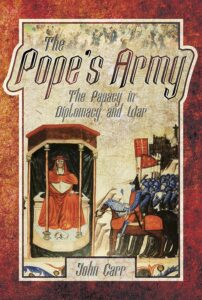
John Carr’s The Pope’s Army: The Papacy in Diplomacy and War offers a comprehensive examination of the military and diplomatic endeavors of the papacy from antiquity to the early modern era. Carr, a seasoned historian and author, delves into the lesser-known aspects of papal history, focusing on the Vatican’s involvement in conflicts for territorial and temporal powers as well as diplomatic spats and sparring between European, African and Middle East powers. His narrative provides a detailed account of the papal states’ military campaigns and the intricate web of diplomacy that characterized the papacy’s efforts to maintain and expand its kingdom on earth.
The book spans almost 2,000 years, with an opening chapter bringing the leadership of the church through the tumultuous times of the areas of persecutions and to the Edict of Milan what allowed Christians to worship openly. The book ends with the aftermath of the unification of Italy and the Popes grappling with the modern age sprung upon them suddenly. Each of the Popes outlined briefly in the book explores major diplomatic and military efforts alongside the major nation states of Europe.
Carr begins with the foundational period of the Papal States, detailing how the papacy established its territorial base in central Italy through the assistances of the Roman Emperors and various Gothic kings. The Crusades have their own chapter, with the formation and support of the religious wars being a major focus of the reforming Popes of the 11th and 12th centuries. The book also covers the Renaissance period, a time of both great artistic achievement but also religious strife with the formation of the Reformation and reduction of Papal influence in Europe spiritually and in Italy temporally. Carr concludes with the Counter-Reformation and the Thirty Years’ War, illustrating how the papacy adapted to the changing political landscape of Europe.
Critical Analysis
Strengths
One of the primary strengths of The Pope’s Army is Carr’s ability to weave together military history and diplomatic analysis. As a veteran book author, he is able to use accounts of battles and the wider operations in campaigns alongside the detailed political and diplomatic efforts and context to provide a balanced and easy to read approach. This approach provides a nuanced understanding of how the papacy’s military actions were often intertwined with its diplomatic goals.
Carr’s narrative is both engaging and informative. He brings engagement out from the pages of history with rich descriptions and insightful commentary to provide additional context for the amateur reader of pontifical history. His portrayal of key personalities, such as Pope Urban II, Julius II, and Leo X, provides readers with a deeper understanding of their motivations and the challenges they faced as they made decisions affecting most of the known world at that time.
Weaknesses
Despite its many strengths, The Pope’s Army has some limitations. One notable weakness is the occasional lack of critical analysis. While Carr provides a thorough account of events, he sometimes falls short in critically examining the implications of the papacy’s military actions. With thousands of years of history to cover, it is not necessarily the fault of the author to focus on some incidences of history rather than others.
Additionally, the book’s focus on military and diplomatic history sometimes comes at the expense of social and cultural context. While Carr touches on the broader impacts of papal actions on European society, these discussions are often brief and lack depth. A more comprehensive exploration of how the papacy’s military and diplomatic efforts influenced the lives of ordinary people would have enriched the book.
Themes and Contributions
The Pope’s Army highlights several key themes that are crucial to understanding the history of the papacy. One such theme is the dual nature of the papacy’s authority. Carr illustrates how the popes were both spiritual leaders and temporal rulers, a duality that often led to conflicts of interest and complex political maneuvering. In the first and last chapter of the book, he emphasizes this with the lack of temporal rule until the end of antiquity and the loss of temporal rule after the Unification of Italy. This theme is central to understanding the papacy’s involvement in military and diplomatic affairs.
Another important theme is the interplay between religion and politics. Carr demonstrates how the papacy’s military campaigns were often motivated by religious objectives, such as the defense and at times, militant expansion of Christendom during the Crusades. At the same time, political considerations, such as maintaining control over the Papal States and countering the influence of rival powers, were equally significant.
While much has been written about the spiritual and theological aspects of the papacy, The Pope’s Army provides a detailed account of its military and diplomatic history. This focus offers a fresh perspective on the papacy’s role in European history and highlights the complex and often contentious relationship between religion and politics.
Conclusion
In The Pope’s Army: The Papacy in Diplomacy and War, John Carr provides a compelling and detailed account of the papacy’s military and diplomatic endeavors. The book’s strengths lie in its engaging narrative, and for the most part balanced approach to military and diplomatic history. While it could benefit from more critical analysis, it remains a valuable contribution to the historiography of the papacy. Carr’s work underscores the complexity of the papacy’s role in European history, highlighting the dual nature of its authority and the intricate interplay between religion and politics.
Paul Aitchison