Ralph Moffatt
Medieval Arms and Armour: A Sourcebook, Volume III 1450-1500
(The Boydell Press, 2024), 218 pp. $75.00
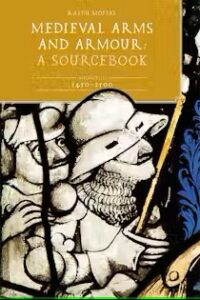
Ralph Moffat’s third, and one presumes final, sourcebook covers the very end of the Middle Ages, from the end of the Hundred Years War through the Italian Wars and to the borders of the early modern period. While Volume III clocks in a bit slimmer than its predecessor, it is nonetheless full of fascinating sources and details of the nuances of medieval weaponry. It contains 78 transcribed and translated sources that cluster on three primary themes: English armouries, French chivalric practices, and the arms and armour production of the Duchy of Milan. That’s not to say that this is the totality of the book’s contents, but rather these are the areas that readers will find to be the most substantial and rewarding. That is, of course, on top of the deep dive into terminology and nuts and bolts details of arms and armour that any student of medieval weaponry will find interesting.
As with previous volumes, each source is transcribed in its original language and if the original isn’t in English the author’s translation is provided below. This remains the best way to do critical volumes of source material and it is excellent to see it continued here – Moffat is very open about doubts he has on his own translations in places and encourages readers to examine them critically. There are also terms where the meaning is not clear, something familiar to any student of medieval military terminology, and hopefully this volume will inspire further discussion of them. I know I personally came across a crossbow term I wasn’t familiar with and I intend to add it to my ever-growing to-do list as something to dig into more.
I am an inveterate crossbow obsessive, and this may be the best volume yet for crossbow ultra-fans like me. In addition to frequent little details that supported ideas I’d long had but hadn’t felt were full proven, there were several references that I wish I’d had when I was working on my last book. This drove home how useful a collection of sources like this can be, both in providing evidence and in giving inspiration on places to look for more. For those less interested in the crossbow, it also contains an abundance of information on the development of gunpowder weaponry, armour terminology and manufacture, and various polearm weapons.
Many of the densest but most interesting references can be found in the many documents relating to the Pale of Calais. Inventories of Calais and its outlying castles provide an abundance of information on how armour was stored, what it was called, and what types were in use. Multiple inventories spanning decades are included in the book, so a diligent reader can track changes between them, although to do so would take some serious commitment as they are incredibly dense reading. I am reminded of David Grummit’s excellent work on Calais and its particularly well-armed garrison and these inventories are the perfect companion to his work. Together they are an invaluable resource on the equipment of one of the most fortified regions in medieval Europe.
For readers who may not relish dense lists of weapons and armour, there is still plenty on offer. There is an excellent sampling of chivalric and other literature from France. The records left by René, Count of Anjou, in particular make for excellent reading. This includes letters between friends – I am of course fascinated by the reference to a crossbow he sent to a friend that was reportedly made by a “Saracen” in Barcelona – as well as treatises he wrote. Samples from Jean de Buil’s Le Jouvencel are always welcome as are the references to weapons for pas d’armes and even accounts of them from multiple sources. These accounts provide more information on how these weapons were used, particularly by the European elite.
Perhaps the most fascinating collection of documents are those related to the Duchy of Milan and its neighbours and their central role in the production of armour during this time. Considered one of the major European centres for weapons and armour production – there are even references in other documents to armour made “in the Milanese style” – this volume includes several documents that dig into the details of how this system worked. This includes letters of safe passage for armourers to travel to European courts to take measurements of royals and other important figures for custom suits of armour, details on merchants’ goods from across Europe, and correspondence on the subject of armourers and their trade. While most of these documents have a strong preference for the equipment of the elitest of the elite of European society there is still some information on the trading of more mundane military equipment. The material on Milan also wonderfully interconnects with many of the other documents to create something of a theme for the work, unusual in a volume like this.
If I am to place some criticism on volume three of Medieval Arms and Armour: A Sourcebook it would be around what it does not contain. Outside of passing reference in one or two documents, Iberia and Central/Northern Europe are largely absent from its corpus of documents. This is a book primarily concerned with a corridor that starts in England, passes through France, and finishes in Lombardy. Particularly given the rise of the Innsbruck armourers and other centres of weapons manufacture in southern Germany during this period, it is unfortunate to see them almost entirely absent from the book. They would have provided a fascinating companion to the material on Milan, their manufacturing rival.
Of course, no book can be all things to all people. Medieval Arms and Armour: A Sourcebook Volume III is a magnificent collection containing many valuable documents that will be of interest to scholars and enthusiasts alike. It could potentially have been even more had its scope been greater, but one must also acknowledge that there are limitations on both what can be compiled and what is economical to publish. Anyone with an interest in medieval arms and armour could learn a lot from this volume, and I know that I certainly will be going through it a second time to dig deeper into the many details it contains.
Stuart Ellis-Gorman
Independent Scholar
[email protected]