Donahue, John F., and Lee L. Brice (eds.)
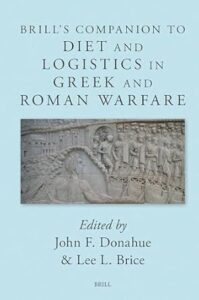
Brill’s Companion to Diet and Logistics in Greek and Roman Warfare
(Brill, 2023), 454 pp. $199.00
The expression, “Amateurs talk tactics/strategy; professionals talk logistics,” became widely popular after the failure of Russia’s initial invasion of Ukraine in February 2022, partly due to poor logistical planning. Of course, at its core, this adage is flawed as success requires the understanding and mastery of tactics, strategy, and logistics alike. More importantly, logistics is an integral part of strategic planning, and every strategy must account for it and is ultimately constrained by it. However, this saying effectively highlights a different reality: tactics and strategy, represented often as the fighting itself and the movement of units on the maps (i.e. grand planning) are inherently more engaging to a broad audience, drawing widespread interest. In contrast, logistics, which often involves mundane administrative work and usually a lot of paperwork, is perceived as less exciting and consequently receives less attention, even in academic circles. For this reason, and in recognition of another universally true adage, “An army marches on its stomach,” the editors of this volume have chosen to take up the glove, while focusing on the diet and logistics of armies in the Greek and Roman world. Fully aware of the field’s underdeveloped state, they do not see this volume as a definitive conclusion or a mere summary of existing research. Instead, they envision it as a stepping stone for future studies, as is evident from its eloquent introduction.
Since the field is riddled with gaps, and many subjects require further research, the editors have made a deliberate effort to include papers going beyond the conventional scope of companion volumes. This collection features new, innovative, and thought-provoking research that reshapes how the material is approached and highlights fresh insights which can be drawn from existing sources. A brilliant example of this approach is the second chapter, the first in the section on diet, authored by Sarah C. Murray. It explores diet and food consumption in Homer, a fascinating subject, especially as the historicity of the text and the occurrence of the war at its centre is hotly debated. Yet, because of its prominent place in Greek culture, the text provides valuable insights. The study exemplifies the potential of interdisciplinary research, as it compares Homeric descriptions with archaeological finds, including faunal evidence from the period. Some of this evidence appears to corroborate aspects of Homer’s accounts, while other findings contradict others.
In contrast, the following paper aligns more closely with traditional companion volumes. In this chapter, Fernando Echeverría examines nutrition and diet in the Archaic and Classical Greek world, devoting two-thirds of his discussion to everyday life, as they are relevant for what was available to soldiers, while only one-third of the chapter is dedicated to logistics and diet in war. His contribution is a solid, well-written study, a quality consistent throughout the book’s different papers. On a similar note, the fourth chapter discusses nutrition and diet in Hellenistic Greece, representing, to an extent, wider Hellenistic patterns. Yet here, Eduardo García-Molina takes a different approach, and focuses on diet and logistics in the context of the military sphere throughout the chapter.
The following two papers share a similar dual focus. The fifth chapter, written by Jeremy Armstrong, examines diet and nutrition in the Republican Roman army, yet devotes a significant portion to describing the general diet and agriculture of the period. This approach is logical, as soldiers typically consumed what was readily available, namely, the same food found in the civilian sphere and so available in the markets. On the other hand, in the sixth chapter, Paul Erdkamp presents the diet in the northern provinces during the imperial period, mainly focusing on what was found and available in military contexts.
The seventh paper shifts the focus to Roman Egypt and the Near Eastern frontier. Here, Kelsey Koon seeks to clarify how Egypt’s logistical system was structured. Her work marks a significant improvement over previous research, although several articles published around the same time as this volume provide even greater detail and resolve additional questions about this system. Her chapter highlights both the fragmentary nature of the available data and the crucial role of faunal remains in expanding our understanding of ancient logistics, while underscoring the remarkable progress this field has made in recent decades.
The next paper, by Matthew A. Sears, is the first in the section dedicated to logistics. Similar to the previous section, the papers here are organised chronologically. In his chapter, Sears explores logistics in Greece from the Archaic to the Hellenistic period (700–200 BCE). His work offers a fascinating examination of the differences between these eras, as well as the varying logistical approaches of different military forces in them.
By contrast, the ninth paper, penned by Thomas C. Rose, addresses how Hellenistic rulers in Greece sustained their garrisons in sometimes hostile cities, and how local populations attempted to drive them out. This paper provides a completely new perspective on a rarely explored topic and discusses often-overlooked events and issues. Moreover, it establishes the need for more research by stressing some of the questions that can, and should, be asked for Greece, as well as many other places, periods and nations.
In the tenth paper of this volume, Nikolaus Leo Overtoom takes a comparative approach, examining Seleucid and Parthian logistics during the great struggle between them in the 3rd and 2nd centuries BCE. His study focuses on the successful campaign of Antiochus III and the failed campaign of Antiochus VII. Conversely, this comparison also highlights the fundamental differences in Seleucid military capabilities between the two campaigns, and the profound impact their defeat by the Romans at Magnesia in 188 BCE had on their army and the region as a whole. This contradicts Overtoom’s claim “It was the Parthians not the Romans, who crippled the Seleucids” (p. 258).
The following chapter, by John F. Donahue, examines Republican Roman logistics. Acknowledging that the subject has been extensively studied, particularly through the influential books written by Roth and Erdkamp, published in 1998-9, Donahue instead focuses on three underexplored aspects of the topic: sieges, deception, and bioterrorism. The first naturally revolves around the prevention of food and drink, and many of the cases presented includes deception from both the besieged and besieger, as both sides often tried to fool the other, and deceive him regarding how much food and drink they still had. In terms of bioterrorism, different cases are presented, like poisoning water and food and so on, often in the context of sieges.
The twelfth chapter, the final one in the section on the logistics of food and drink, focuses on Roman organisational structures. In this paper, Bret C. Devereaux examines logistics during the Republican period and the early Principate. In the first part, he analyses the roles of key functionaries and institutions during the republic, including the Senate, generals, quaestors, and private contractors. The second part shifts to a broader discussion of the logistical system as a whole during the Principate. While Devereaux frequently highlights the many gaps in our understanding, he still makes it clear that the actual system functioned extremely effectively.
The following section presents two case study papers, each focusing on a specific aspect of military logistics. The first, by Gregory Francis Viggiano, examines the logistics of diet in Greek armies as gleaned from the works of Herodotus and Thucydides. Viggiano emphasises Herodotus’ capability as a historian and how both authors provide valuable discussions and insights on the subject. However, he also notes that these works still contain relatively little information on logistics compared to Xenophon, the first writer to systematically refer and analyse this topic in his writings (p. 343). The second case study, the penultimate paper of the volume, explores the role of equestrian officers in logistical operations during several Roman campaigns of the 2nd century CE, specifically under the reigns of Trajan and Marcus Aurelius. In this study, Marc Kleijwegt examines six inscriptions belonging to six different individuals, analysing their careers and examining the points at which they were assigned logistical responsibilities.
The fifteenth and final paper of the volume is, among other things, a conclusion and summary of what was explored. Nonetheless, it also serves as a platform for Lee L. Brice to explore and present what the field is still missing, how the papers of the volume can be the foundation for future research, as well as indicate the many topics that still need to be examined and improved in pursuit of a more holistic understanding of diet and logistics in antiquity.
In conclusion, this is a fascinating volume filled with excellent papers, many of which are innovative and even groundbreaking, both in their perspectives and methodologies. This is not merely a companion volume but a foundational cornerstone in the ongoing transformation of this ever-growing and evolving field. The contributions here are significant in content, well-written and highly accessible.
Having read many edited volumes, I know they are often a mixed bag, with some often too difficult to engage with or poorly structured. This volume, however, is exceptionally well-constructed and organised, making it one of the best edited volumes I have ever read. It is a must-have for university libraries and for anyone passionate about ancient warfare and military logistics alike. Unfortunately, its steep price makes it less accessible, leaving us hopeful that Brill will eventually release a more affordable softcover edition.
Haggai Olshanetsky
University of Warsaw