Robert Allred
Mysteries of the Norman Conquest: Unravelling the Truth of the Battle of Hastings and the Events of 1066
(Frontline Books, 2022), 248 pp. £18.75
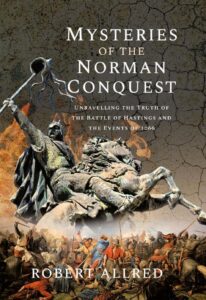
Robert Allred’s Mysteries of the Norman Conquest is an re-examination of one of the most foundational episodes in early English history, the Norman invasion of 1066 and the events surrounding the Battle of Hastings. He blends a topographical investigation, critical analysis of primary sources, and historical revisionism, Allred offers an account that challenges traditional narratives and site identifications long accepted by both academic and popular audiences.
At the heart of Allred’s inquiry is a sustained critique of the received wisdom that situates the Battle of Hastings at the site now occupied by Battle Abbey. Drawing upon a combination of primary chronicles (such as The Anglo-Saxon Chronicle, William of Poitiers, and Orderic Vitalis) and on-the-ground geographic study, Allred proposes alternative battle locations and logistical scenarios that disrupt the consensus shaped since the 19th century. Allred adds to the historiography with his personal level of details and personal engagement with the sites.
The strength of the book lies in its methodical, if at times speculative, reconstruction of the 1066 campaign trail. Allred is most compelling when treating the Norman logistical chain, the terrain of Sussex, and the march of Harold Godwinson’s forces. He bolsters his argument about the precise location of the battle through his terrain analysis and questioning long held assumptions from both textual and surviving material evidence.
A reader can appreciate taking a different approach to the research and presentation of the battle itself, it sometimes ventures into conjecture without sufficient evidentiary support. For example, while Allred challenges the traditional identification of Senlac Hill, alternative proposals are occasionally undermined by a lack of archaeological corroboration. It isn’t to say he is wrong, but there is no evidence to back up his claim any more than long held beliefs. The book is well researched and informed however it does slant into a popular historical writing style at times. Despite these caveats, Mysteries of the Norman Conquest is a valuable contribution to the ongoing conversation about 1066 and its historiography. For scholars, the book will serve as a prompt to revisit familiar sources with renewed scrutiny. For general readers, it offers an accessible and thought-provoking retelling of a well-known story, reminding us that even the most “settled” historical events remain open to interrogation.
Allred’s work is in keeping with a heavy landscape study with historical textual analysis, doing the work of military history out in the field that is to be commended. Though not the final word on Hastings, Mysteries of the Norman Conquest is a welcome intervention that challenges complacency and invites both scholars and enthusiasts to look again and add to the rich discussion on the topic of 1066.
Paul Aitchison
Florida College