Michael Brown
Scotland, the Wars of the Roses, and European Politics: War and Diplomacy in the Later Fifteenth Century
(Woodbridge: Boydell & Brewer) xx+298 pp. $145.00
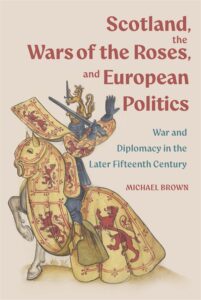
Recent decades have witnessed a flourishing of scholarship on late medieval and Renaissance Scotland. The themes of dynastic politics, military affairs, and diplomacy have featured prominently within this corpus. The year 2026 also has seen three significant publications in this arena, including Stephen Boardman’s The First Stewart Dynasty: Scotland, 1371-1488 and Amy Blakeway’s War and Governance in Scotland, 1543-1559: Destruction, Reconstruction and Reform, both of which have been published by Edinburgh University Press. The third notable book to emerge this year – the subject of this review – is Michael Brown’s impressive new study of fifteenth-century Scotland.
Traditionally, fifteenth-century Scotland was regarded as something of a forgotten century. The epoch was nestled between the period which saw Scottish sovereignty re-established under the Bruce dynasty and their Stewart successors in the fourteenth century and before the era of the so-called Renaissance monarchy of James V (d. 1542) and his daughter, Mary Queen of Scots (d. 1587). During this period, the long fifteenth century of 1371-1513, the kingdom of the Scots was perceived to have been a fractious entity, the king no mightier than his most powerful subjects. As a consequence, the role of Scotland and the Scots in wider insular or continental politics was believed to have been fairly circumscribed as the Stewart monarchs struggled to assert their authority over a wayward and largely autonomous nobility. As this very welcome book demonstrates, Scotland’s monarchs did indeed face significant challenges from their own nobility (including lineages such as the Black Dougles and Meic Domhnaill lords of the Isles) but this did not stop Scottish kings and queens from occupying a prominent position in continental European politics. By focussing on the course of conflicts such as the Hundred Years War and Wars of the Roses, this study reveals that Scotland’s engagement with mainstream European affair was anything but peripheral; rather, the political and dynastic stock of Scotland’s rulers continued to rise as these conflicts progressed.
The introduction provides a succinct overview of how scholars have typically understood Scotland’s place in European politics during this period. As Brown points out, aside from studies on trade and commerce, historians of Scotland have themselves been reluctant to explore the kingdom’s enmeshment in European politics. Equally, Scotland’s internal problems and the various struggles between the Stewart monarchs and their magnates should not seen as being unusual in a European context: the same period witnessed similar dynastic conflicts across Europe as the monarchs of France, Aragon, and Scandinavia each sought to forcefully incorporate the great magnatial houses into their respective emerging state apparati. The first chapter hones in on the period 1410-1449, a critical phase in the Hundred Years War. The decision of Philip (d. 1467), duke of Burgundy, to ally with Henry V of England (d. 1422) placed the Valois monarchy under enormous military pressure. Scottish manpower thus became a highly valued resource for the French crown and it is estimated that at least 10,000 Scots fought for the Valois, with many acquiring lands and titles as a reward for their loyal service. The chapter, however, also points out that the kingdom of the Scots was not simply locked into a triangular relationship with England and France; rather, Brown examines the Stewarts’ marriage diplomacy during this period and the kingdom’s links with the royal and ducal houses of Burgundy, Brittany, and Castile.
Chapter two focuses on the troubled relationship between James II (d. 1460) and the Black Douglases. Brown reminds us that the king’s difficulties in dealing with the House of Douglas were not necessarily reflective of an overmighty magnate imposing himself upon a weak monarch. The monarchs of western Europe all faced similar challenges: for instance, Charles VII of France (d. 1461) had to overcome the challenge posed by the ducal lineages of Brittany, Anjou, and Burgundy, each of which enjoyed significant diplomatic and dynastic connections beyond France’s borders. The struggle with the Black Douglases should be viewed in this context. Indeed, the power of such magnatial families is telling and it was largely the fear that the Black Douglases would rebel against him that prevented James II from dispatching meaningful military support to Charles VII during the Gascony campaigns (1449-1453). While the chapter discusses James II’s European diplomacy, it makes clear that the king’s military priority was nearly always England. Though the outbreak of the Wars of the Roses might have caught James somewhat unawares, it provided him with a golden opportunity to exploit English weakness and extend his influence southwards. James, however, did not live to capitalise on this conflict and was killed when one of his own cannons exploded next to him in August 1460.
The third chapter re-considers Scotland’s role in the early phase of the Wars of the Roses. As noted, the outbreak of the English civil war initially provided the Scots with a distinct advantage and the attention of Europe’s monarchs was fixed on Scotland following the flight of Margaret of Anjou (d. 1482) and Henry VI (d. 1471) there in the wake of Towton. Once again, the inability of the Scots to exploit this conflict needs to be considered within the context of western Europe’s ever shifting alliance blocs. The ascension of Louis XI (d. 1483) to the French throne, for example, changed the diplomatic calculus significantly and the French’s king’s willingness to ride rough shod over long-established alliances placed severe strain upon the Auld Alliance. By 1464, the minority council of James III (d. 1488) was considering other options, including a closer relationship with Burgundy. The fourth chapter brilliantly examines the evolving political and dynastic milieu that characterised Scotland’s place within European affairs from this point through to 1477. This period witnessed a renewed struggle between the ducal house of Burgundy and the French monarchy; this conflict was not confined to northern Europe, rather it drew in a host of other powers as both entities sought international alliances. Brown considers how the frenetic and uncertain (and often contradictory) nature of continental European diplomacy was a key factor in pushing the Scots into a closer relationship with their erstwhile enemies, Yorkist England.
The decision to seek peace with England in 1474 saw Scotland’s political and military utility in European politics decline significantly: after all, their main value to France was as a counter-point to the English. The Anglo-Scottish peace of 1474 did considerable damage to Franco-Scottish relations and saw Scotland lose the one ally that had (since the 1290s) helped keep English aggression in check. Chapter five investigates how James III attempted to navigate this changing world. It locates the king of Scots’ difficulties within the context of the new dynastic wars that emerged following the death of Charles the Bold in 1477. The chapter demonstrates the extent of Scotland’s vulnerability during the early 1480s and highlights how the English crown was able to exploit Scotland’s’ (relative) isolation by sponsoring the pretensions of James III’s estranged brother, Alexander (d. 1485), duke of Albany. The final chronological chapter centres on the late reign of James III and the early kingship of his son, James IV (d. 1513). Scotland was, of course, wracked by internecine feuding and problems during the late 1480s and early 1490s, not least of which saw James III killed by his own subjects at the battle of Sauchieburn in 1488. However, as Brown makes clear, Scotland’s domestic issues were not unique: rather, the challenges besetting the young James IV need to be viewed as being largely typical of European politics. Ultimately, it was Scotland’s long-established ability to threaten a weakened England (following the Tudor accession in 1485), coupled with James IV’s mixed but largely successful diplomacy, that saw Scotland’s position as European player restored.
The final two chapters examine Scotland’s position in European politics from thematic perspectives. Chapter seven focuses on the regional nature of the kingdom, emphasising, on one level, the difficulties faced by Scotland’s rulers in governing their realm. For instance, communications were hampered by the nature of the kingdom’s terrain, while topography also presented numerous challenges to raising armies. Added to this was the issue of dealing with powerfully entrenched local aristocracies, be they in the borders, Argyll, the Hebrides, or Orkney. The book, as a whole, emphasises how Scotland sat upon a maritime nexus. This chapter further underlines how these sea-lanes connected Scotland (both diplomatically and economically) to the continent; however, overseeing such a vast world was challenging and the Stewarts’ ability to exert themselves on the European stage could, at times, be hamstrung by recalcitrant dynasties in western Scotland (or, indeed, Ireland). The final chapter provides a succinct overview of the book’s core arguments, considering how the Scots – for better or worse – negotiated a particularly challenging century in European history.
Overall, this is a hugely impressive piece of scholarship. Of course, Michael Brown’s book should be essential reading to anyone studying late medieval Scottish history. However, this study should also attract a much wider readership for the insights it can offer into the history and course of the Hundred Years War, the Wars of the Roses, and the bitter rivalry between the French kings and the dukes of Burgundy. Furthermore, the book also offers a detailed assessment of how a small kingdom like Scotland navigated successive domestic and international challenges. Scholars who are interested in the origins and evolution of the early modern state and how similarly sized entities overcame such trials will find much of comparative value here.
Simon Egan
Queen’s University Belfast