Conor Whately (ed.)
Military Literature in the Medieval Roman World and Beyond
(Brill, 2024) 454 pp. €189.00
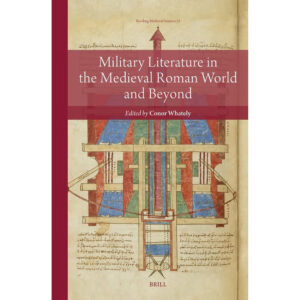
‘Military Literature in the Medieval Roman World and Beyond’ is Volume 8 in Brill’s ‘Reading Medieval Sources’ series and consists of 15 chapters dealing with different aspects of military treatises, their production, reception and use, along with an introduction by the editor and an epilogue by John Haldon. The stated intention of the volume is to give the reader “some sense of the issues occupying scholars working on these texts”. A one-sentence review would state that it fulfils this brief very well.
Conor Whately has pulled together an impressive roster of contributors with a range of levels of experience and areas of expertise. The focus is not just on the texts themselves, but how they were used, and by whom. Most of the treatises had quite long lives, and it is an interesting quirk of the genre that a text that was supposed to have instructional value in the 4th century AD could still be being extensively quoted in the 10th century and beyond. Does this tell us anything about warfare, or is it more of a product of literary conventions? Do people rely on old information because it is still useful or because they have to frame advice as coming from the ancients in order to be treated seriously? This book contains a variety of approaches to these and other related questions.
It is also, unlike some edited volumes, a book that can be read from cover to cover. Doing so gives the reader a sense of the breadth of research and there will be few people who will have a comprehensive knowledge of all the approaches described within. Anyone with a decent familiarity with the ongoing influence of Vegetius into the Medieval period, and there is a lot of Vegetius in this book, may well not have considered the implications of comparing Byzantine treatises with Chinese military writings. It is also refreshing to see a couple of chapters on both descriptions and illustrations of artillery. Individually, not many of the chapters provide significant research that is not covered more comprehensively in the other works of the distinguished contributors, but the book impresses most when taken as a whole.
So, who is this book for? Anyone wanting to know the current state of scholarship related to military treatises would be well served by picking up a copy. The breadth of contributors and topics ensures excellent coverage of recent research. As a result, it would be particularly useful to any new PhD student in any related field, who would find the collected bibliographies alone an invaluable resource containing many useful publications that they may otherwise have missed.
There are a couple of points about this book to note though, one trivial and one less so. It could have benefited from a final look over with another pair of human eyes. There are usually one or two spelling or grammatical errors in each chapter, often of the kind that a computer might not pick up, such as the typo ‘marital’ instead of ‘martial’. Hardly unusual or serious, but their consistency is notable.
The other is technically out of scope of the publication, though it is mentioned in the introduction so I feel like I should mention it here. What of the future of research into military treatises? What is needed to push to discipline beyond what we currently have? The answer given here is ‘more of the same’ and comparing the contents of this book with how the literature looked around 20 years ago it is a justifiable answer. There is so much more high-quality work out there now, much of it by contributors to this volume. More of the same would indeed be good, but if there are revolutionary technologies that would make any similar volume in 20 years time look radically different, they are largely absent here.
One notable exception is Catharine Hof’s chapter, which makes comparisons between textual descriptions of fortifications and the physical remains. It’s an example of the kind of interdisciplinary research, combining history, archaeology and technology (the 3D illustrations work well), that may be much more common in a review of the current state of military treatise research in 2044.
Not that this should detract from appreciation of this volume, which is focused very much on the present. As a survey of the state of research into military treatises and an overview of the many different approaches being pursued, it does its job admirably.
Phil Murgatroyd
University of Bradford
[email protected]