Dierk Hagedorn & Daniel Jaquet
Dürer’s Fight Book: The Genius of the German Renaissance and his Combat Treatise
(Greenhill Books, 2022) 320 pp. $45.00
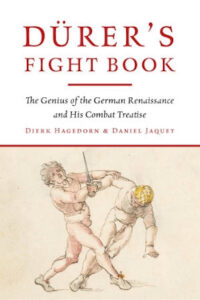
This is a beautifully produced exemplar of an early modern Fechtbuch manuscript, by two authors who are well versed in both the academic and the modern practitioner side of the subject-matter. Dierk Hagedorn has previous published critical editions of German fight books. Daniel Jaquet has written extensively on the fight book corpus as embodied research and the academic study of martial arts.
The original manuscript is today kept in the Albertina in Vienna, Austria, shelf number HS 26232. It is a miscellany, combining different manuscripts written at different times by different authors and treating different matters. The hand of Albrecht Dürer can indeed be identified in certain parts of the manuscript attributed or dedicated to him, and the authors assist in identifying those sections. 175 of the 200 fight technique illustrations are considered Dürer’s, the remainder probably done by his workshop. One of the presumably ten scribes of the text passages was probably also Dürer.
However, the authors are surely right when they maintain that Dürer is unlikely to have been the one to have structured the content of the illustrated fighting section. Albrecht Dürer (1471-1528) was born and grew up in Nuremberg. After completing his apprenticeship in 1490, he travelled throughout Europe, but periodically returned to Nuremberg to live and work there. He was of course, already during his lifetime, one of the foremost artists of the German renaissance. Given the time and place, it is very likely that Dürer practiced the fighting arts after the contemporary fashion, and numerous studies and drawings show his fascination with fighting bodies. But he is not known as a fencing master himself.
The main, illustrated part of the manuscript deals with different Bloßfechten techniques, i.e. unarmoured combat on foot, produced around 1512. The disciplines covered include wrestling; longsword; dagger; and langes Messer, in paired weapon arrangement. A final section features unpaired weapons, e.g. longsword against langes Messer or dagger against a long blade. Up to illustration 120, each technique is glossed with a short text, in a consistent hand. The remaining illustrations are uncommented.
The subsequent parts of the manuscript are purely text, covering also the other two general Fechtbuch subjects, fencing in armour on foot as well as mounted combat. The sections were evidently produced at different times and were written by different hands. Each of them likely also served, as the authors argue, different purposes.
The volume reproduces the complete manuscript in facsimile. The images are of good quality, and though the text is rendered rather small, the quality is good enough to allow the original text to be read, ideally aided by a magnifying glass. This part is followed by a transcription of the original Early New High German as well as an English translation, presented side by side.
This presentation makes it easy to follow the text and the authors’ interpretation-by-way-of-translation, and quibble with them if one were so inclined. Of course, one does so at one’s peril. As mentioned, both authors have solid academic pedigrees in using and editing late medieval German fight books. Also, both authors are practitioners in the modern interpretation of the techniques described in the manuscripts (commonly termed historical European martial arts, or HEMA – a pastime this reviewer engages in as well, though at a much more modest level). In addition to Bloßfechten with the weapons treated in the manuscript, both authors are also experienced in armoured combat on foot and have insights into mounted combat.
The translations are correspondingly circumspect. They adhere to the German syntax as closely as possible and tread a middle ground between translating the Early New High German technical term for a technique, at the risk of misinterpreting it, and preserving the original term in the translation. While a rigorous application of the latter approach satisfies the purist, it typically makes for a trying experience for the user uninitiated into the terminology. A reader unfamiliar with the style and conventions of late medieval and early modern German fight books will likely still find it difficult to follow the techniques described, but that is in the nature of the subject-matter, not the translation.
A short introduction and codicological appendices complete the work. These two sections will be of key interest to the student of Fechtbücher as a phenomenon of late medieval to early modern pragmatische Schriftlichkeit, and both again reflect the authors’ intensive and extensive study of the subject.
Like other examples of the time’s pragmatische Schriftlichkeit, the fight books in many respects remain baffling. The remarks made by Stuart Ellis-Gorman in his review of Axel E. W. Müller’s “Gunpowder Technology in the Fifteenth Century: A Study, Edition and Translation of the Firework Book” (posted on this site on August 4, 2025) apply to the fight book corpus as well. At a very fundamental level, we do not know why the fight books were written, or their intended audience.
As the authors say, it is clear from the matters presented that the work dealt only with one-on-one situations. Not only that, but most situations show paired weapons, an unrealistic assumption outside a regulated setting. So it was not intended as a manual for battlefield techniques or tactics. But even in a one-on-one configuration, what exactly was the intent? Was it self-defence, as one might view the wrestling or the dagger techniques? Was it duel – bearing in mind that Dürer’s patron, Holy Roman Emperor Maximilian I, had finally banned judicial dueling, a practice that the Church had consistently opposed and that had long fallen into desuetude? Or was it sport?
As the authors explain, the Dürer Fechtbuch partially addresses the issue. It says that some situations are Schimpf (play) and some Ernst (serious), but it does not specify which qualification applies to which techniques. The better view is that the qualification was not technique-dependent, but situation-dependent: A member of the town’s night watch would want to employ non-lethal techniques when quelling a rowdy but still relatively harmless drunken brawl. Defending oneself against highwaymen would call for less restraint. The authors are surely correct in warning against snap judgements on the manuscript’s target audience or situation.
Much more thought and differentiation are required. The bibliography will assist the reader wishing to delve deeper into these questions. It is kept short, but it references the main researchers active in the area.
The appendices finally provide technical information. The first appendix discusses the sources employed for the various sections of the Dürer manuscript and will be of particular interest to practitioners. The intimate knowledge the authors have accumulated on the various streams of the historical fencing traditions shines through. Some sources are self-evident, as when the Dürer text is a straight copy of a known earlier witness. Others are more speculative, and there is always the possibility that the compilers of the Dürer miscellany had access to manuscripts which are lost or have not yet been identified.
Further appendices deal with the codicology, the watermarks on the paper, the arrangement of quires, and so on. Figures and tables assist in understanding the information synoptically. A glossary completes the work.
There are matters which in this reviewer’s opinion could have been improved on. The use of endnotes instead of footnotes means that the text for note 1 on p. 162 is found on p. 277. Thankfully, the hardback edition comes with two bookmark ribbons. The first appendix then discusses the possible sources for the techniques recorded in the Dürer Fechtbuch (pp. 284-88). For a synoptic view of the material, the reader is referred to Figure 7 (pp. 298-99). The structure of Figure 7 is not explained there, one needs to have paid attention to the explanation on pp. 278-88. It is only here that the reader learns that Figure 7 sets out the witnesses for each weapon or technique which preceded the Dürer text and served as sources, and later texts which might have been influenced by the Dürer manuscript. For this purpose, it would have been helpful if Figure 7 had included a timeline and a reference to the explanatory section. The key to the abbreviations used in Figure 7 is in a separate Table 2 on pp. 304-09. Again, Figure 7 does not point to Table 2, this information must be gleaned from Appendix 1. Unfortunately, it is not clear how Table 2 is structured; alphabetically it is not.
Overall, though, these issues have more to do with the publisher’s policies and the challenges inherent in presenting the information in different dimensions, each of which enables fresh insights. Hagedorn and Jaquet have provided us with well executed and reasonably priced work on the Dürer Fechtbuch, one that both historical European martial arts practitioners and academic researchers of late medieval to early modern pragmatische Schriftlichkeit will find useful, informative, and entertaining.
Jürg Gassmann
Independent Scholar