Clive Hart
The Rise and Fall of the Mounted Knight
(Pen & Sword, 2022) 276 pp. $42.95
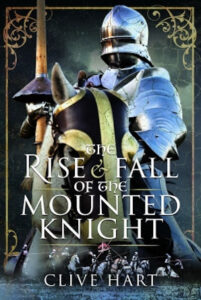
This is a book that addresses a subject with a long history of academic controversy, and does so at several levels. Clive Hart is distinguished from many other authors on medieval knights by being not only a rider, but a practitioner of jousting in full plate armor, the iconic event of knightly life. Being familiar with horses myself, though not having achieved Hart’s level of prowess, I particularly appreciate the practical insights Hart’s hands-on experience add to his reading of the sources and his analyses of modern military historians. I also participate in HEMA, the modern effort to recreate the historical European martial arts, referred to by Hart as well (225-26).
The task Hart sets for himself is to trace the concept of knighthood from early history to today. A knight is defined (pp. vii-viii) as someone who (1) is mounted; (2) is a member of the petty nobility; and (3) subscribes to a code of chivalry. This code of conduct may be implicit, the individuals do not have to consciously undertake to follow a formal document, they must only observe its tenets.
Taking the criteria in turn: Hart appends an “author’s note” section to various chapters, where he provides a rider’s or jouster’s gloss to the more academic treatment of the chapter’s subject-matter. Chapter 5 then focuses on the knight’s horse, as do pp. 226-30.
Surprisingly, given the amount of ink spilled over the last two centuries discussing the knight, his horse has received remarkably little attention. This began to change roughly ten years ago, with articles, monographs and edited volumes written by academics with horsey backgrounds themselves.[1] Hart’s book fits comfortably in this new wave.
The first myth Hart dispels is about the size of the historical warhorse; Hart (95) sets it at 14½ to something over 15 hands (147-155 cm). While I personally would, as already suggested by John Clark, favor a typical size at the lower end of that spectrum, at least for the period before 1500, I fully agree with Hart’s proposition that the horse’s conformation is more relevant to its capabilities than mere size.[2] A short-backed horse, especially one built to come into collection easily, would be a fighter’s preferred mount. These are the traditional hallmarks of Iberian types, as variously attested in contemporary narrative and literary sources.
My own research and experience lead me to disagree with this author on certain points, where I feel there are more complex arguments to be considered. I agree with Hart that the riders’ ability to bring their horses into collection on command, and the horses being trained to maintain collection for an extended time, are crucial for advanced, effective mounted combat. Where I disagree with Hart is his assertion that there is no evidence for collection being practiced before 1500 (105); in my reading, the descriptions in various older sources only make sense if the riders had their horses collected. The other disagreement is regarding the “shock charge” of cavalry into a dense, deep infantry formation (115). I agree with Hart that such a charge is possible, but just once. Rather, both battle descriptions and tactical advice of the time speak of a comparatively slow approach to an infantry block, probing for gaps or seeking to provoke infantry into coming out of formation. Once the cavalry were in among the infantry, and here again I agree with Hart, their superior bulk and height indeed made them highly effective. These tactics required heightened tactical awareness, superior riding skills, and a horse trained to a level which enabled the rider to exploit the opportunities.
To support his argument, Hart refers to experiences in reenactments, and I can confirm his observations from my own experiences. However, I see two crucial differences: The first is that in modern reenactments, we are lucky to be able to assemble 10 mounted fighters and 30 infantry, both properly armed and equipped. This is a far cry from the medieval infantry squares numbering fighters in the thousands, arrayed eight or more ranks deep. The second difference is that in modern reenactments the infantry’s ability to protect itself is severely restricted since injuring a horse is off-limits. This, incidentally, was also an iron gauntlet-clad rule of historical knightly tournaments: The trained warhorse was simply too valuable to waste.
These are the only substantive disagreements I have, and I would argue that if my objections are valid, then Hart’s basic thesis is actually reinforced. I agree with Hart that the knight’s effectiveness in battle was not (just) a function of his courage and his readiness to apply violence. It further required a careful, dedicated, and also sensitive training of the knight’s indispensable partner, his horse. Sophisticated riding skills were the hallmark of the knight. Additionally, following Ramon Llull, training warhorses for profit was one of the few status-compatible income-earning opportunities open to the knight, other than war or tournaments.
And horses are not interchangeable, they have individual characteristics. As Hart says (115), our horses tend to fall into one of three broad categories. The first think we’re bonkers, and will refuse to participate in our silly and dangerous games. The second will go along with us, just to please us. The third join in the activity with gusto, relishing the opportunity to bowl over an infantryman in their way, or barge into a herd member. There is no reason to assume this did not apply to the historical horse.
Hart addresses the other two criteria, that of petty nobility and a code of chivalry, extensively. Thankfully, he is not rigorous about applying them to the subject-matter of his analysis – had he done so, discussions of battlefield cavalry for instance would have captured only a narrow, misleading, and ultimately incomprehensible snapshot, given that a large proportion of the medieval heavy cavalry were commoner sergeants or men-at-arms. In his analyses, Hart acknowledges that both concepts, nobility and chivalry, changed by time and place, and that modern historiography has failed to come to a consensus on clearly defining either.
Hart’s arguments are supported by a very extensive bibliography (14 pages), including both original sources in translation, with some gems among them, and modern publications. Reviewing the latter, the secondary literature (with notable exceptions) tends toward what I might term the conventional approach to medieval and early modern military and general history, leaning heavily toward an Anglo-Saxon point of view. This is a pity, since Hart is careful to explore the controversies underserved by the conventional narratives, and to expand his purview beyond Anglo-Saxon historiography’s focus on 1066, the Crusades, the Hundred Years’ War, and the Wars of the Roses. There is a wealth of specialized pre-2020 publications, most of them written in English though authored by a wide international spectrum of academics, that support Hart’s conclusions and would have enabled him to be less tentative.
As an example, Hart makes good use of the life of William Marshal as well as that of his hapless son Gilbert.[3] Marshal would also have made a useful reference for the section where Hart discusses the knight’s “daytime job”, when he was not fighting (158). Hart writes there that the decline in preponderance of the knights’ fighting role meant that knights in the fourteenth century began diversifying into administration, politics, and law. In fact, these roles were always part and parcel of the knight’s job. The use by William Marshal and Isabel de Clare of the tools of feudal rule and knights’ functions within that framework can be observed in the Marshals’ crash program to develop the economy, administrative organization, and infrastructure of their lordship of Leinster in the early thirteenth century.[4]
An index completes the book and assists in quickly getting to key topics.
In presentation, the book is appealing, though Hart is ill served by the editing. In several chapters, the endnotes do not align with the numbering in the text, and there are typos ranging from the annoying to the involuntarily amusing. A reasonably competent reader will be able to work through these glitches.
The wide range of Hart’s book does not make it easy for the reviewer. I have focused here on the parts where I believe readers are offered insights they will find hard to obtain elsewhere. The book also deals with military history and the development of the concepts of knighthood and chivalry. Readers may have their own opinions on these matters, but in the context of the book, they are necessary to situate and explain Hart’s choices and conclusions. This book is a worthwhile read for anyone, whether academic or general reader, interested in the impact of the factors horse and of the practicalities of moving in armor, on both iconic and ephemeral events of history.
Jürg Gassmann
Independent Researcher
[email protected]
[1] For a partial overview see my review of Emma Herbert-Davies & Anastasija Ropa (eds.), The Horse in History: A Festschrift in Honour of John Clark (Trivent Publishing, 2025), published in the Nuova Antologia Militare 6.23 (2025), 543-50, DOI: 10.36158/979125669174618 (open access). Several further important works have appeared in the intervening year. John Clark’s seminal 1995 book The Medieval Horse and its Equipment (republished by Boydell in 2004) is also referenced by Hart.
[2] Jürg Gassmann, “Combat Training for Horse and Rider in the Early Middle Ages,” Acta Periodica Duellatorum 6.1 (2018), pp. 63-98.
[3] Hart relies on the latest edition of David Crouch’s book William Marshal (Routledge (Taylor & Francis), 2016), and Paul Meyer’s early partial translation (into French) of Marshal’s biographic poem, published 1901. There is a more recent translation by Nigel Bryant, The History of William Marshal: The true story of England’s greatest knight (Boydell, 2016).
[4] Billy Colfer, “Monastery and Manor: William Marshal’s settlement strategy in Co. Wexford,” in William Marshal and Ireland, ed. by John Bradley, Cóilín Ó Drisceoil, Michael Potterton (Four Courts, 2017), 249-267.