Darren Baker
Crusaders and Revolutionaries of the Thirteenth Century: De Montfort
(Pen & Sword, 2020) 272 pp. £12.50
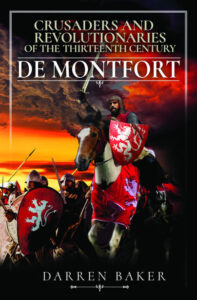
Darren Baker undertakes the task of chronicling the family history of the de Montfort’s, a family whose name was formerly heard in the passages of power from England to the Holy Land. The book traces the de Montfort dynasty from its obscure eleventh-century origins as Parisian foresters to its zenith in the thirteenth century, a period that saw them challenge kings, lead crusades, and inadvertently lay the basis for modern parliamentary democracy. If the reader is looking for a book specific to the De Montfort’s of England, then this is not the book for you. If you are curious about how the De Montfort’s came to be in England, then this book will provide you with the background generation by generation. The goal of the book is to bring to life the family in all their complexity, moving beyond the legendary figures of Simon V and VI to present a holistic view of the entire clan, their victories, and their downfall.
The English chapters shift the focus from crusading conquest to reform, faction, and civil war. Simon VI’s marriage to Eleanor, sister of Henry III, brought the family into English royal politics. Baker traces the deterioration of Simon’s relationship with Henry III and the rise of the reform movement. Simon’s parliaments and his insistence that royal authority should operate through counsel were significant, but the book is most convincing when it presents those reforms as products of thirteenth-century aristocratic politics rather than backwards looking as modern representative government.
The later chapters on the sons who were exiled from the extended family, the murder of Henry of Almain at Viterbo, and Eleanor de Montfort’s Welsh marriage are among the most interesting parts, yet they pass more quickly than their importance deserves. These chapters show that Evesham did not end the family immediately but instead scattered the surviving de Montfort’s into new courts and conflicts. More sustained analysis of this post-Evesham diaspora would have strengthened Baker’s argument about the dynasty’s wider European character.
A major strength of the book is the combination of deep research and readable prose. Baker uses chronicles, letters, administrative records, genealogical evidence, and later traditions to reconstruct a family whose members repeatedly used the same names and operated in several political worlds. The family could be pious, courageous, loyal, opportunistic, vindictive, and extraordinarily violent, regularly within the same generation.
For those who are not professional medieval historians and are unfamiliar with the difficulties of the Albigensian Crusade and the political, religious, and social relations of southern France in the thirteenth century, those chapters can be a bit difficult to get through.
Overall, the book situates the family within the greater context of their time, from the brutal Albigensian Crusade, which shaped Simon V, to the revolutionary parliamentary reforms of his son, Simon VI, which forever changed the course of English governance. While the immense detail and elaborate political webs may require concentration, the book as a whole is made worthwhile by the writing of the De Montfort story.
Paul Aitchison
Florida College