Scott Manning
Joan of Arc: A Reference Guide to her Life and Works
(Rowman & Littlefield, 2023) 281 pp. $167.95
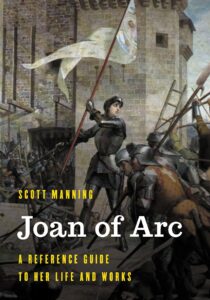
This reference work is an extensive accounting of archival sources and historical concepts connected to Joan of Arc. Far from taking a bibliographic approach or one that strictly frames it as a work in military history, Scott Manning’s reference text on Joan of Arc is a research tool for experts in the study of her life and military career. The work synthesizes historical concepts, people, places, and events in Joan’s life from birth to the nullification proceedings held between 1450 and 1456. (3)
Manning intends for this contribution to the field to improve the historical accuracy of how historians contextualize Joan. The Introduction identifies inconsistencies ranging from naming conventions, such as the use of French vs. Anglicized versions of names, to the precision in word choices that reproduce historical inaccuracies. Therefore, Manning’s work can be considered as a contribution to the standardization of writing practices and historical accuracy in Johannic scholarship.
From the content to the structure, Manning consistently considers standardization as a guiding principle to inform all sections of the text. Structurally, the text consists of 8 sections that are typical of monographs: naming conventions, map, chronology, introduction, the main text (the reference entries), appendices, bibliography, and index. Although these are standard components found in most academic works, it is worthwhile to note them as they each support Johannic scholars in proactively using this reference text. Additionally, each component of the text highlights areas in the historical analysis of Joan’s life that Manning argues requires standardization and great attention to precision. For instance, the author’s main message to editors and translators regarding anglicizing French names is that names must remain consistent throughout a piece of publication. (xi) As for the map, it is not particularly unique, but nonetheless intends to standardize Joan’s geographical contexts in medieval France as it relates to the entries on places and military campaigns. (xiii) The chronology is especially useful in presenting a clear timeline of social and cultural developments, which shaped Joan’s life and military career from 1407 to 1498. (xv-xviii)
The introduction is particularly useful in understanding Manning’s efforts to create this reference tool and the need for it in both historical practice and publishing. In it, Manning considers the breadth of archival documents available on Joan of Arc as contributing to the inaccuracies in how historians and her biographers have written about her life and military career. Here, Manning frames—though at times indirectly—the purpose of his reference work as contributing to the accuracy of scholarship, particularly in popular thematic strands of Johannic historiography, including works that focus on her “cross-dressing, militancy, monarchist fervor, virginity, evocation of “Jesus Mary,” and encounters with saints […].” (p.2) A more direct reference to how each section of the text responds to these problems would more effectively identify the significance of the text as a response to the problems the author has identified in historical and biographical writing and analysis.
The author also spends considerable time in the text’s introduction (and rightfully so) stressing the distinctions between the historical and mythical Joan, the latter of which he connects to the inaccuracies and inconsistencies in scholars’ treatment of historical records. This discussion is useful for junior scholars to learn about major historical topics on Joan of Arc and the difficulties they can anticipate encountering when working with both primary and secondary sources.
Particularly notable in the Introduction is the absence of a detailed historiographical framing of the reference book. Are there other reference works like it that support the study of Joan of Arc’s life? How have scholars sought to standardize historical facts on Joan before the creation of this work? While there certainly is no shortage of recommended primary and secondary sources found in the Bibliography, framing the text within the practices in the field can be further developed in the Introduction. For example, Manning’s discussion of the inconsistencies in the years spanning Joan’s life and military career would have benefited from directly referencing the chronology section of the reference work. (3) With any new tool, it is important to make its ugtility as tangible as possible to users.
As for the main body of the text, the structure is as expected: the entries are organized alphabetically. Each alphabetical section contains concepts, terms, people, places, and objects. For example, in the section D, “Duval, Guillaume” appears as an entry and the description accompanying it explains this man’s identity as a Dominican friar who was present in one of Joan’s condemnation trials. (77) The significance of this entry and others like it in the reference work is useful in reminding scholars of the different actors who appeared in the sources connected to Joan. Other entries are broader by comparison to aid scholars in the historical accuracy of using terms with precision. For example, “Duke” appears as an entry which begins with a description of its etymology, political function of those who held this title in medieval France, and the division of the region into duchies. From there, the entry poses the argument that “[m]uch of the causes and the events of Joan of Arc’s military career can be told through the lives (and deaths) of dukes” and recounts the men who held this title during Joan’s military career. (75) While the individual entries in each alphabetical section function independently of each other, they nonetheless offer touch points for connecting entries to one another by bolded, cross-referencing terms.
Also notable in the entries is that some descriptions offer historiographical information and framing, while others do not. The historiographical framing is a useful feature in grounding specific terms in scholars’ methodological approaches and historical interpretations, especially for researchers new to Johannic scholarship. However, similar to Manning’s provision of arguments in some entries but not in others, historiographical framing in select entries hints at the author’s own evaluation of secondary sources. These entries are particularly terms that fall within the broad thematic strands he identified in the Introduction, including military terms like “Artillery.” (20) Manning vaguely addresses this in the Introduction: “[the text] ventures into historiography only where it demonstrates the evolving perspectives of specific documents, people, and events over time.” (4) Clearer connections between the content of the entries and themes in the Introduction would be helpful in the latter. Alternatively, a historiographical essay of the author’s own analysis of the field or within a specific theme in Johannic scholarship may have been useful in reinforcing the arguments and scholarly contributions of this reference work.
A similar problem is evident in the Appendix section of the text. Appendix A to H are indubitably useful and quick references on treaties, her dictated letters, and historical figures. However, there is no explanation provided to users informing them why these sources have their own Appendix, while others do not. A short introduction here similar to the bibliography section of the text can address the appendix items.
Manning’s work offers an important contribution that supports the research and writing of scholarship on Joan of Arc. While this reference work is an important reference text for experts in Johannic scholarship, I am not convinced that it is appropriate for all researchers—particularly students new to the study of History or historical analysis—as Manning intended it to be. (3) The reference work caters to scholars who know what they are looking for in the entries and how that information can be used in historical research. For researchers new to Joan, Manning provides a list of entries that contextualize her life standard in what may be found in first-year lectures on the Hundred Years War. Therefore, this list of entries includes “Hundred Years War”, “French Civil War”, and “Treaty of Troyes”. (3) For inexperienced researchers, the danger is in taking the archival documents mentioned in the reference work literally. For instance, Appendix E on Joan’s letters simply refers to them as her letters. Students new to Joan or researchers new to historical analysis may take this title literally to mean that Joan herself wrote rather than dictated them to a scribe. The text assumes some expertise from its readership, which is fine, but this ultimately means that this reference work is best for experienced researchers.
Overall, this reference guide is an important contribution to the research and writing processes in Johannic scholarship. The reference work seeks to make accessible historically accurate information about Joan of Arc evident in its comprehensiveness, which is also a testament to the author’s expertise and commitment.
Mary Anne Gonzales
Independent scholar
[email protected]