By Nicholas Savy
The first events of the Hundred Years’ War in Guyenne prompted the consuls of Cahors to strengthen the defences of their town. As early as 1345, the stories that reached them of the capture and sack of Bergerac [1] , as well as probably royal directives, led them to complete the system of fortifications: in less than 2 years, the isthmus of the peninsula where the town is located was completely closed, by increasing and completely taking over an embryonic fortified line built there at the end of the 13th century; to the south, a curtain wall running along the Lot was built from the Porte des Morouls [2] to the Pont Valentré [3] ; construction and maintenance work on the fortified works continued throughout the war.
The walls were useful at all times: by isolating the city from the outside, they prevented undesirables, vagabonds, plague-ridden fugitives and bandits from disturbing – even just by their presence – the townspeople or robbing them; by channelling the different traffic flows towards the gates, they also facilitated the collection of the various tolls. But their main role consisted of protecting the population and their property from physical attacks, and of supporting the different tactical devices adopted according to the threat to be countered. The measures only concerned part of the defenders when a well-targeted danger was of low or medium intensity, with all the men only going up on the walls in the presence of an extremely perilous situation; once this maximum stage was reached, retreats were planned to face the possible advances of the attacker.
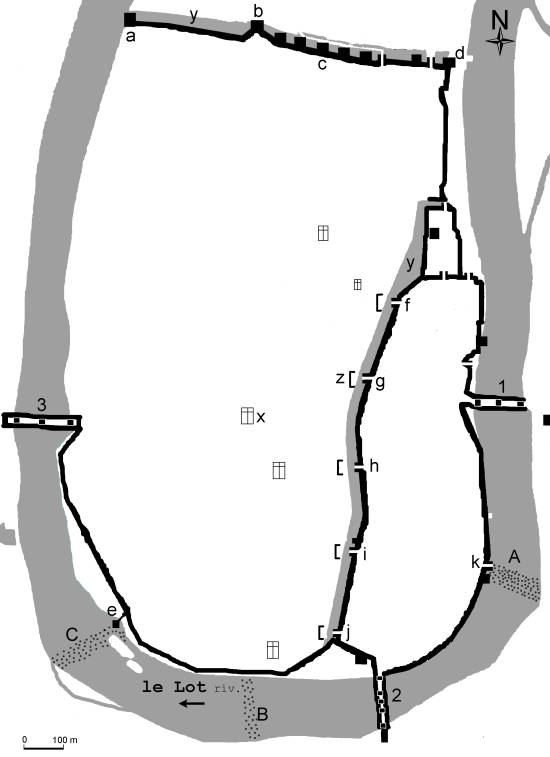
-Door: f) of the Augustins; g) Albenc; h) Garrel; i) Neuve; J) of the Morouls.
-Bridge: 1)New; 2)Old; 3)Valentré.
-Ford: A)St. Urcisse; B)St. Georges; C)Canons.
-Others: x)convent; y)moat; z)barbican.
A – Defense devices.
The city could fear attacks from several types of enemies: these could be more or less powerful companies or neighboring lords, and the arrival of a strong army from the King of England could not be ruled out. If the former had only limited means, it was different for the royal armies, numerous and well-equipped with various equipment. Arrangements were made according to the type and strength of the adversary: they could only interest a limited number of defenders, or involve all of them by making them hold the places assigned to them on the walls.
1 – Limited devices.
The majority of hostile actions directed against the city were carried out by companies operating in the vicinity. Having only limited numbers that did not allow them to completely invest the perimeter of the city, they could not attempt a proper siege; they were therefore obliged to concentrate their forces on a given point of the enclosure in order to try to storm it, and then penetrate inside the city in the event of success. These actions were naturally directed against the weak points of the fortifications.
In 1359, the consuls held men on the walls near the Porte de la Barre, in order to oppose the daily raids that Jean de Gourdon led in this sector, accompanied by Benoit de Jean and Aymar d’Uchel and their troops. The three cronies tried to enter the city, leaving aside the strong defenses of La Barre, to attack the palisade of Pal. However, the sufficient number of defenders placed nearby allowed them to be easily repelled [4] .
The suburbs were ideal targets for the companies and bands because, often poorly defended, they allowed the roaders to carry out traditional plundering and pillaging without too much difficulty. Indeed, the city had neither the material and financial means, nor sufficient human resources to equip them with solid permanent defenses. Taking the essential precautions required first knowing the enemy’s intention to attack, but also having a minimum delay between the moment when one became aware of it and the moment when the attack was actually to take place; if these conditions were not met, the inhabitants of the suburbs had no choice but to flee and take refuge behind the city walls. On the other hand, when the consuls had time to put in place protection for the barris, it was often effective. In 1372 in particular, it was known of an upcoming “English” attack directed towards the suburbs, and the latter were provided with many defenders; They did not have to fight, because their presence alone discouraged the attackers, who gave up the game without trying anything [5] .
On the part of the enclosure protected by the Lot, the fords were, with the bridges, the only passages allowing access to the foot of the walls, so they logically attracted certain attacks. The means adopted could be preventive and punctual, as when in August 1381, the consuls warned that the English were to attack on the night of the 13th by the ford of Saint Urcisse, placed men on standby in the riverbed in order to oppose them [6] . Faced with an intense and imprecise threat, the defense of the sensitive points was reinforced for the duration of the danger. Also in 1381, in the month of September, men were kept on the various fords for sixteen days to oppose the enterprises of Ramonet Del Sort and Bertrand de Rustang [7] .
Despite the permanent state of insecurity in which the city found itself, urban activities continued and each inhabitant had to be able to go about their business; the consulate found it in its interest, because the wealth produced allowed it to raise numerous taxes, all the more essential since it had to face the significant expenses generated by the war. It was therefore important to properly identify and quantify the threats, so as to mobilize only the sufficient number, and thus allow the continuation of economic activities.
2 – The city in a state of defense.
Only an enemy with a large and well-equipped army could attempt to besiege the city; this only happened once in 1369, but several armies passing through the region on campaigns, as well as rumors or erroneous information, led the consuls to believe that the city was about to be invested. To face these real or supposed dangers, the city was put in a complete state of defense, and all available combatants joined the posts prescribed for them. In 1374, the 1,760 defenders were divided into companies of twenty to six hundred men, each placed under the command of a captain [8] .
The companies were mostly responsible for a portion of the fortifications that did not present any particular weakness: to the north, between the Saint-Jean and Saint-Mari towers, three of them shared the defense of the area, with a total of 190 men, or about one every 2.40 meters; from the Saint-Jammes mill to the Saint-Jean tower, 290 defenders crowded the walls, divided into five companies [9] , the average in this sector being one fighter every 3.80 meters.
The area extending from the area around the Pont Vieux to the Saint-Urcisse church, manned by six hundred and ten fighters [10] , had a very high density with an approximate average of one man every 0.75 metres; this high number was made essential by the presence of the Saint-Urcisse ford, which in summer offered a direct access route to the foot of the walls surrounding the gate of the same name. It was therefore imperative to repel all enemy attacks there, because if the latter managed to cross the walls in this sector, they would have gained a direct foothold in a residential area. From there, no serious obstacle stood in the way of taking the city from the inside, which would have fallen at worst in a few hours, and at best in one or two days with fierce and well-led resistance. The mission incumbent on the defenders was therefore vital, but also particularly simple: to repel the enemy without any thought of retreat. In this context, tactical choices and articulations were inevitably limited: a single captain commanded these fighters, grouped in the largest company.
To a lesser extent than at Saint-Urcisse, the earthworks and the Pal tower were also better equipped than the other sections, with three companies totaling 160 men [11] ; distributed over the 300 meters of the structure, they were separated from each other by an average of 1.80 meters. This number may seem low for a structurally vulnerable structure, which had to channel the hopes of enemy breakthroughs. Three captains shared command of the troops, so as to set up a mobile defense, requiring speed of decision and execution: each in charge of a segment of the defenses, they could however quickly direct their soldiers towards the points where the enemy was making an effort, then return to the initial position if necessary, leave again or be reinforced in turn by another company, and so on according to the movements of the attacker.
Finally, the curtain wall and the towers that stretched to the south between the old town and the Valentré bridge received, excluding the latter, a particularly low number of combatants with only 160 men [12] for one kilometer of fortifications, which increased the average space between each soldier to more than 6.20 meters. Here again, the defense of this sector was essentially mobile, under the orders of three captains, because it only had two well-defined weak points, the fords of Saint-Georges and Chanoines, the rest of the curtain wall being protected by the depth and width of the Lot. The troops were distributed as follows: ten men permanently assigned to the defenses of each ford, the rest of the troops being ready to intervene on one or the other, but also on the entire sector. In this way, the numerical weakness of the personnel engaged is easily understandable; on the other hand, it is less so in the area extending between the Valentré bridge and the Pal tower, the “defense plan” of 1374 not mentioning the presence of defenders [13] .
The city, not having sufficient human resources to man all the fortifications equally and effectively, had to adopt several combinations in order to best distribute the defenders on all the works, and in particular on those presenting weaknesses, structural or otherwise. Concerning the latter, priorities had to be defined, and the consuls naturally favored the protection of the old city; its main weak point, at Saint-Urcisse, was manned by a large number of fighters who compensated for the easy access offered by the ford to the enemy. For the weak sectors considered secondary, an attempt was made to compensate for their weaknesses by a more elaborate command, playing on speed and mobility to counter the number.
B – The tactic of defending the fortified perimeter.
Once the whole city was in a state of defense, the besieged naturally tried to repel the assaults, but it was nevertheless wise to foresee a possible failure, and the crossing of certain works by a sufficiently strong enemy. In this case, the last redoubt was constituted by the old city, centerpiece of the defense, because it was the culmination of possible retreats planned from the weak points of the enclosure.
1 – The old town, the last stronghold and centerpiece of the defense.
The old town naturally imposed itself as the ultimate defensive stronghold, because it still contained the majority of the buildings and urban wealth. The western part of the peninsula probably saw its urbanization, already loose before the war, shrink further, the buildings located near the old walls having been razed for the needs of defense. The west of the city therefore still had a very pronounced rural character, unlike the east where the old wall had been maintained and increased, thus remaining the strongest part of the fortifications.
The only real weak point, at Saint-Urcisse, was only vulnerable in summer, when low water opened the passage of the ford, and the number of defenders assigned there was then sufficient to resist strong attacks; the rest of the eastern facade was covered by the Lot, while to the west, the Grand Fossé protected solid walls that had been reinforced several times. The importance and role of the old town is reflected in the number of troops assigned to it: in 1374, when it was initially put into defense, while some of its walls were not in direct contact with the attacker, it received 1,120 defenders out of the 1,760 available [14] . With the strongest fortifications and two-thirds of the defenders, the old town was the centerpiece of the defensive system.
2 – The successive planned retreats.
The outer wall can be divided into two sides, one of which can be described as “strong” and the other as “weak”: the first consisted of the eastern façade of the old town, the best-defended part of the entire wall with 920 men in 1374 [15] ; the defensive plan of the urban enclosure was based on the premise that this façade could not yield to enemy attacks, retreats being possible only on the “weak” side, to the west. The consuls were aware that the Pal earthwork was not a sufficiently serious obstacle to prevent a strong party of determined attackers from storming it; this merlon was not replaced by a masonry curtain wall, of rather poor construction, until the beginning of the 15th century [16] ; it therefore remained a flaw in the defensive system for more than fifty years. The Valentré bridge was also a vulnerable structure, its location at the foot of the hills being particularly unfavourable.
Simple logic dictated that the companies assigned to the northern defenses should be withdrawn, because if the Pal earthworks gave way, all the works on the northern front could easily be taken from behind, making them difficult to defend. However, once the peninsula was open to the enemy, it was useless and dangerous to continue their defense: useless because nothing prevented the attackers from taking control of the western part of the peninsula and attacking the heart of the city; dangerous because their defenders could find themselves surrounded in their positions, thus depriving the defenses of the old walls of essential arms.
Between the Pal levee and the western walls of the old town was an open, cultivated area that extended for over half a mile; it extended a similar distance from the Pont Valentré. This area represented a buffer zone, of intermediate defence: an enemy who succeeded in crossing the Pal or the bridge would have to be fought along this stretch, before he reached the first advanced defences of the old town. In May 1369, John Chandos’ troops succeeded in crossing the Pal and pushed deep into the peninsula, until they were stopped in this cultivated area, well before they reached the old walls [17] ; The map of the lands devastated by the English troops shows that their extreme advance stopped along a line passing close to the monastic enclosures of the Minorettes, the Carthusians and the Cordeliers, which suggests that the defenders relied on these buildings to repel the attackers. The defensive plan therefore anticipated the need to fight in the interval formed by the “rural” sector of the city. Simple logic dictated it: if the defenders had retreated directly inside the old walls, they would have denied themselves any possibility of pushing the enemy out of the peninsula; thus losing all freedom of maneuver, all they had to do was sustain a regular siege. Their only – and uncertain – salvation then rested on the possibility of holding out long enough to tire the enemy and thus cause him to leave. Moreover, the consuls and their captains had certainly noticed that the northern fortification line, once turned around by the enemy, was difficult to defend by them, given that the Saint-Jean and Morlas towers were open at the throat, and that the flanking towers only faced north.
The possibility of a total withdrawal within the old walls was not, however, excluded. In 1374, more than 180 men were kept on the western fortifications of the old city, despite the fact that they were far from being in direct contact with the enemy. Among these troops was part of Arnaud Delpech’s company, which reinforced that of Guillaume de Lafon on the walls near the Garrel portal ; Arnaud Delpech and the rest of his company defended the Valentré bridge [18] . However, the Garrel portal was connected in a straight line to the Valentré bridge by the Balandre road: forced to abandon the bridge and withdraw, Arnaud Delpech would naturally have headed towards the Garrel portal , where he would have reformed his company to continue the fight from the old walls. Each company initially placed on the new fortifications of the peninsula, must thus have had a clearly defined withdrawal point on the old walls. In the event of an irresistible push by the attacker, this would have allowed the defense to recover while avoiding any harmful hesitation, because each portion of the old walls would have been immediately filled with fighters, something impossible to achieve during an unforeseen and disorderly retreat – a rout – which would have seen some sectors outnumbered, while others would have been almost empty of defenders. The retreat of the fighters on the northern front did not necessarily imply that of those in place at the Valentré bridge: during the siege of 1369, it seems visible that its defenders remained in place when the English pierced the Pal and pushed south, passing the bridge which thus remained a thorn in their rear.
The consuls, well supported by their captains, had a clear view of the resistance capacities of the fortified urban enclosure, and above all had to take into account limited human resources. Their reflections on defense led them, with a certain tactical spirit, to optimize the capacities of each work, playing on its strengths and compensating for its weaknesses with the help of a rational use of the defenders, and to plan different retreats towards the old city. In this way, an attacker impossible to contain to the north would have progressively lost strength to reach the foot of the old walls; once this end was reached, the people of Cadur could still protect the most important part of their city. The realism of this reasoning was demonstrated during the only siege suffered by the city in the 14th century, in 1369: the defense of the city had received reinforcements in men and artillery, sent by the Duke of Anjou [19] ; This did not prevent Chandos’ English from overwhelming the northern defences, and penetrating deep into the peninsula. The fallback arrangements were then put into effect, and made it possible to stop the attackers well in front of the western barbicans of the old town.
End Notes
[1] Arch. Mun. Cahors, FF 24, 17th century copy of the request for contribution made by the consuls of Cahors to the chapter in 1345; the description of the sack of Bergerac is on pages 2 and 3.
[2] This gate was located at the junction of Rue des Maures and Place des Carmes.
[3] There remains a portion of more than 100 meters of this wall on rue du Lot, a stone’s throw from the Valentré foyer.
[4] Lacoste (G.), General history of the province of Quercy , 4 volumes, Cahors, Girma, 1886. , re-edited Marseille, Laffitte Reprints, 1982, vol. III, p. 163-164.
[5] Ibidem , p.235.
[6] Ibidem , p.271.
[7] Ibid .
[8] Lacoste, (G.), op.cit. , t.III, p.241-243.
[9] Ibid .
[10] Ibid .
[11] Lacoste, (G.), op.cit. , t.III, p.241-243.
[12] Ibid .
[13] Lacoste, (G.), op.cit. , t.III, p.241-243.
[14] Lacoste, (G.), op.cit. , t.III, p.241-243.
[15] Ibid .
[16] Lacoste, (G.), op.cit. , t.III, p.336.
[17] Lartigaut, (J.), The immediate supply of a town, Cahors in 1369 , in Proceedings of the 42nd congress of regional studies organized by the Society of Lot Studies in Souillac and Martel on June 19, 20 and 21, 1987 , Cahors, Imp. Dhivers, 1988, p.170-180.
[18] Lacoste, (G.), op.cit. , t.III, p.241-243.
[19] Lacoste, (G.), op.cit. , t.III, p.206.
We thank Nicolas Savy for his permission to republish this article.